
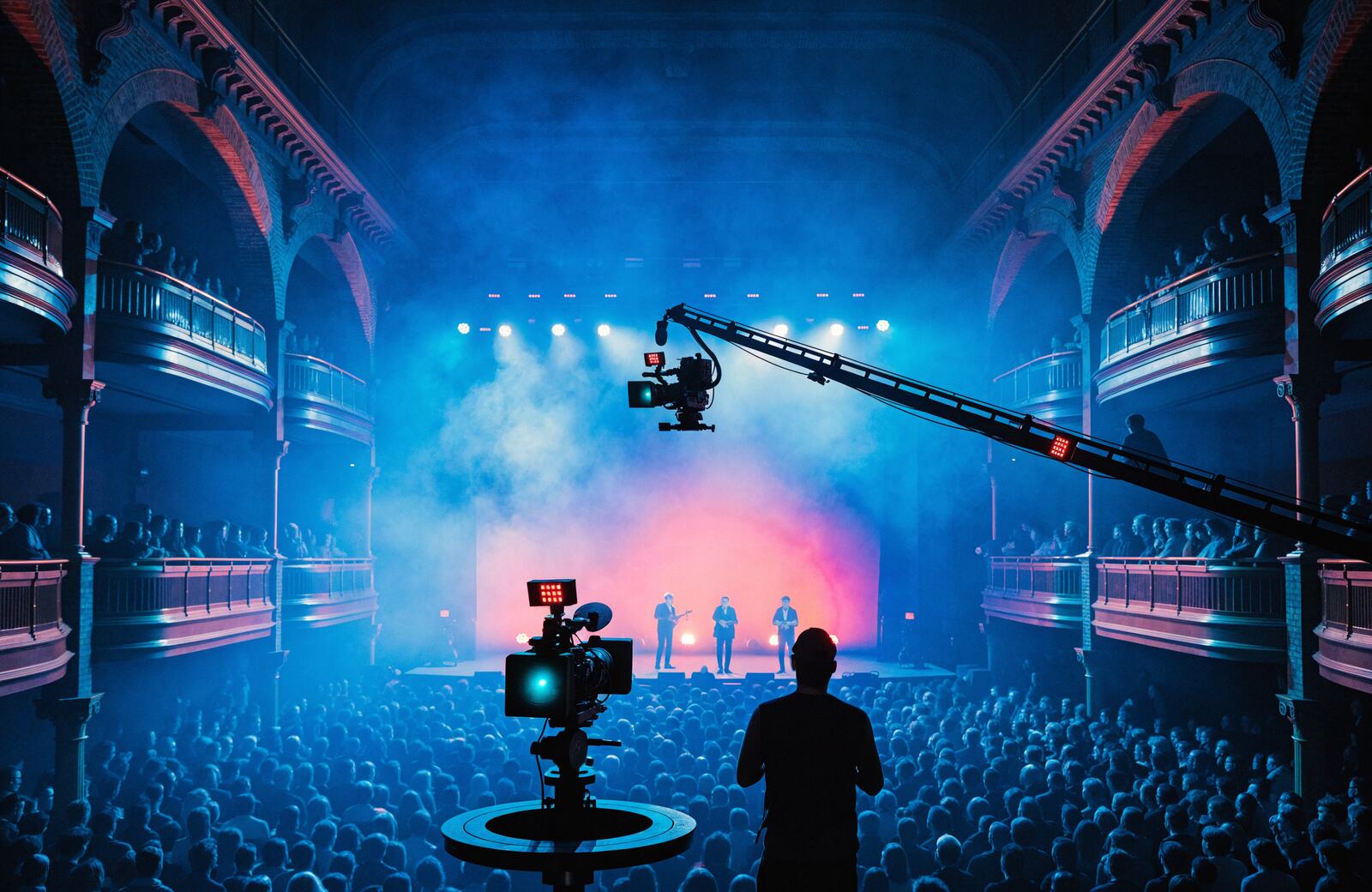
Apple Music Hall Opens At Battersea. A 600 Cap Room Built To Film Your Set, Not Fill Every Friday
Apple announced on 22 September that it has built a 600 capacity concert room, Apple Music Hall, beneath its UK headquarters at Battersea Power Station. It is not a club looking for a Friday night crowd. It is a broadcast facility with a stage in it, designed so that one show produces a finished Spatial Audio recording, a broadcast ready mix and a multicamera film, with selected performances livestreamed to Apple Music listeners around the world.
The news landed in the same week the BBC reported that 45 London music venues closed last year. That coincidence will tempt people to cast Apple as either a saviour or a threat to the capital's live circuit. For a UK recording act the more useful question is narrower and more commercial: if the offer of an Apple date arrives, what is it worth to your catalogue and your release plan, and what does it leave untouched on the tour you still have to book?
What Apple has actually built under Battersea Power Station
The specification reads like a television studio that happens to sell tickets. The stage is 38 feet wide and can be set conventionally or in the round. A 48 speaker spatial sound system surrounds the audience. Behind the stage sit two recording and mix studios, and the room is hardwired for more than sixteen cameras feeding a dedicated broadcast control room, with iPhone capture alongside conventional broadcast cameras. Every performance can be captured as a multitrack recording and mixed in Spatial Audio, either live or afterwards.
The building also takes in Apple Music's radio studios, moving from King's Cross, along with space for DJ mixes, writing camps and rehearsals. Programming is being handled with Communion ONE, the independent UK promoter formed from the merger of Communion and FKP Scorpio UK. Ticketing arrangements and the opening programme had not been published at the time of writing; Apple is taking registrations of interest at applemusichall.com.
Oliver Schusser, Apple's Vice President of Apple Music and International Content, was explicit about the purpose when he spoke to BBC News: "We're not trying to compete with anyone. We're going to run the venue like a venue, with tickets and everything, but the sole purpose for us is to do great work with artists, to connect artists with fans, and to broadcast the content on Apple Music." Take him at his word. This is a content engine, and the content is your set.
A filmed date is a release asset, not a gig
Most acts at the level this room will book, somewhere between a busy club tour and a first run of 2,000 capacity halls, judge a London show on three things: tickets sold, merchandise per head and the industry people it brings through the door. An Apple Music Hall date should be judged on different terms, because its real output is not the night itself. It is a live album's worth of Spatial Audio masters and a concert film that exists permanently on the platform where a large share of your listeners already are.
Mazin Tappuni, Managing Director of Communion ONE, described the room as one where "the production quality is world class, livestreaming to fans across the world, from a live room where every square foot has the artist and their fans in mind." That production quality has a price in the ordinary market. A multicamera shoot with a broadcast truck, a multitrack recording and a separate immersive mix would cost an independent act a sum that rarely makes sense against one night's box office. Here it arrives as part of the booking.
The consequence is that the value of the date depends almost entirely on what you do with the recording and the film afterwards. An act that plays the room, enjoys the night and lets the footage sit on a platform page it never mentions has spent a rare opportunity on a very good gig. An act that plans the date around its release calendar has bought itself a second release.
Where a one off Apple show fits your release calendar
Timing decides most of the value. There are three sensible positions for a filmed date, and each does a different job for the catalogue.
The first is the week of an album release. Played to 600 people and streamed globally, a show built around new material gives the record a live launch that reaches listeners outside London, and the Spatial Audio versions of the new songs give Apple's editorial teams something distinctive to programme alongside the studio versions. The risk is crowding: a release week already carries radio, press and in store dates, and a live film released into that noise can be lost.
The second is the gap between the second and third singles, typically two to four months after an album, when streaming curves flatten and a campaign needs a reason to be talked about again. A live recording of the album played in full, or the strongest six songs reworked for the room, restarts the conversation without asking fans to wait for new material.
The third is the catalogue position, and it is the one most often overlooked. An act with two or three albums behind it can use a filmed set to put older songs back in front of listeners who arrived with the latest record. Live versions sitting beside the originals on the platform lengthen the life of songs that have already earned their studio costs back, which is precisely where a catalogue makes its money.
The contract questions to settle before you accept the date
Apple has not published the commercial terms for artists playing the room, and until it does, every point below is a question rather than an answer. Ask them in writing before the date is confirmed, and have them answered by someone who reads recording contracts for a living.
Start with ownership. Who owns the multitrack recording and the Spatial Audio masters, and who owns the film? If the artist or the label receives them, on what licence can Apple use them, for how long and in which territories? If Apple retains them, what can the artist do with the footage on its own channels, and can the audio be released as a live album elsewhere?
Then exclusivity. A window during which the recording and film sit only on Apple Music may be perfectly acceptable, but its length decides whether you can release the same performance on other services while the campaign it was built for is still running. A six month window agreed casually can quietly remove a live album from half of your listeners' platforms at the very moment it would have helped.
Then the existing paperwork. Most signed acts will need their label's consent, since a new recording of their repertoire usually falls inside a recording agreement. Publishers will want to know about the synchronisation of songs to picture. Session players and any guest performers need to have agreed, in writing and before the cameras are hardwired, to being recorded and filmed, and on what fee. The same applies to any cover you intend to perform, which has its own clearance route for filmed use. A date that ends in a dispute over who consented to what will cost more than the production saved.
What a camera room cannot replace on a normal tour
A single filmed night, however good, does not do the work of a tour. It does not build a following in Leeds, Glasgow or Bristol, where fans become regulars by seeing you in a room they can reach. It does not generate the merchandise income that pays for a van and a crew across three weeks. It does not give promoters in those cities the ticket history they need before they offer a bigger room next time.
Nor does it replace the grassroots rooms that make the step to 600 capacity possible in the first place. Few acts arrive at an Apple booking without years of 150 and 300 capacity shows behind it, and the London circuit that trains those acts is the one that lost 45 venues last year. We have written before about how grassroots venues subsidise the careers they launch, and nothing about a room in Battersea changes that arithmetic. Apple Music Hall adds a remarkable room at the top of that ladder. It does not add a rung lower down.
There is also the audience itself. A room built to broadcast places the paying crowd inside a production, and the night will feel different from a sweaty headline show where the only camera is on a phone. Some acts will thrive in that setting and some will play within themselves because the stakes feel higher. Know which one you are before you say yes.
The practical approach is to treat an Apple Music Hall date as one line in a release plan rather than a replacement for any part of the touring schedule. Keep the regional dates, keep the London headline show that sells to your own fans, and place the filmed night where the recording and the film will do the most for the catalogue.
An invitation to play a room with sixteen cameras and a 48 speaker system is a compliment and an opportunity in equal measure. It is worth taking seriously, and worth taking with the contract questions answered, the release calendar open on the table and a clear plan for what happens to the footage the morning after. The act that walks in with that plan leaves with an asset. The act that walks in without one leaves with a very good night and a recording someone else decides how to use.