
Fender Wants the Stratocaster Shape. What It Means for the Guitar in Your Case
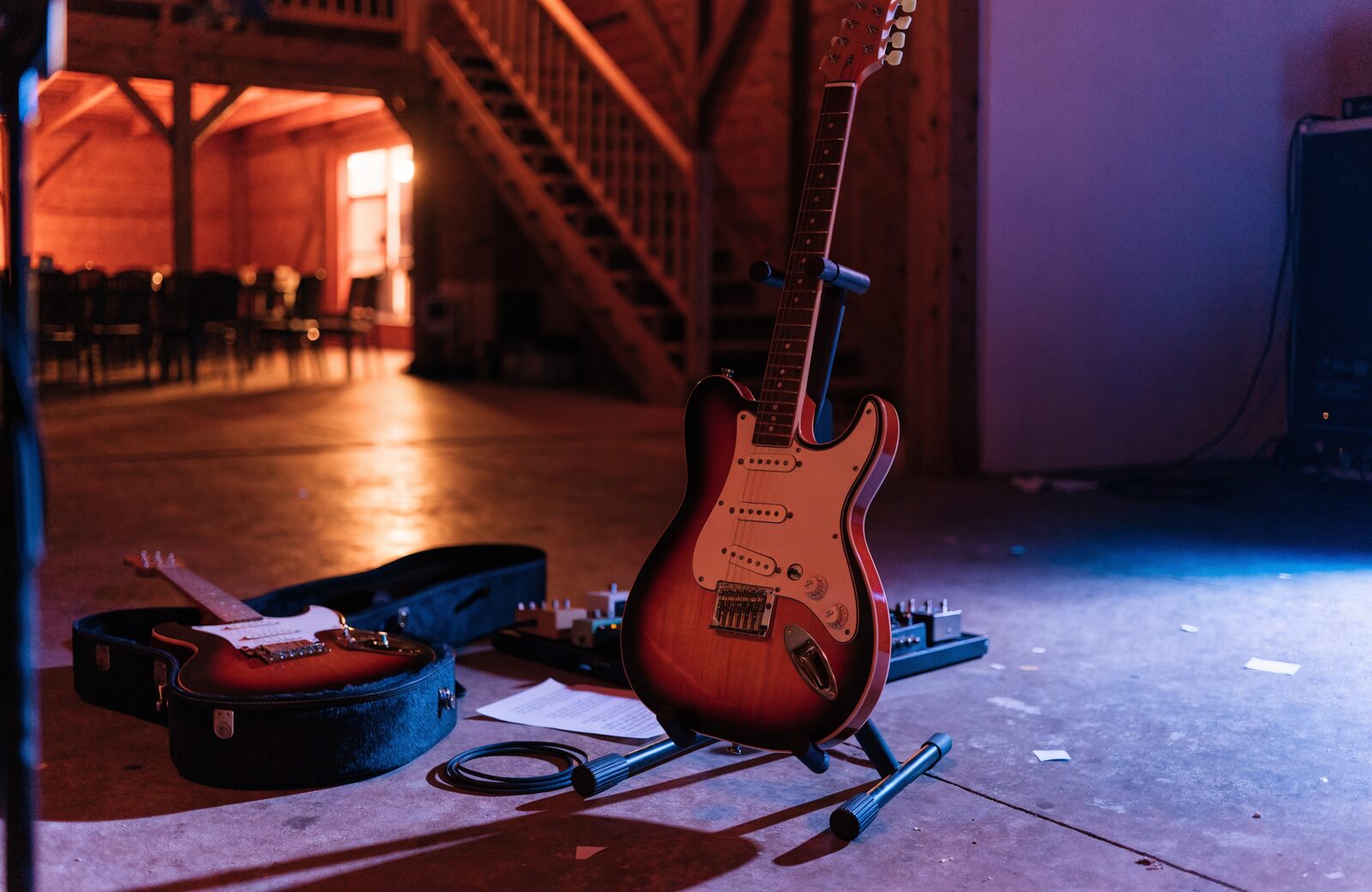
Open the cases backstage at almost any wedding, corporate party or session in the UK and the same silhouette comes out of most of them: a contoured double cutaway body, three single coils and a vibrato bridge. Sometimes it says Fender on the headstock. Very often it says Yamaha, Squier, PRS, Suhr, Harley Benton or nothing at all. That shape is the closest thing the electric guitar has to a standard, and since spring 2026 Fender has been telling the industry, on the strength of a German court ruling, that it owns it.
The case has not finished, and its first serious test is still ahead. But the campaign built on it has already reached around sixty companies, and its outcome will shape what working guitarists pay for the instrument they use more than any other. Here is what has happened, what it could change, and what a working player should and should not do about it.
How a Düsseldorf default judgment became a Europe wide campaign
On 22 December 2025 the Regional Court of Düsseldorf ruled in Fender's favour against Yiwu Philharmonic Musical Instruments Co, a Chinese company selling Strat shaped guitars into Germany through AliExpress. The court accepted that the Stratocaster body is a copyrighted work of applied art under German and European Union law. Fender publicised the decision in March 2026 and described it as creating enforceable rights against every guitar with the Stratocaster body shape made, sold or distributed in the European Union.
Two details matter more than the headline. It was a default judgment, given because Yiwu never turned up to argue its case, and it came from a court of first instance, so no higher court has reviewed it. Fender has tried this route before in another form: in 2009 the United States Trademark Trial and Appeal Board refused its applications to register the Stratocaster, Telecaster and Precision Bass body outlines as trade marks. Copyright is a different argument, and it is the one that has now worked once, unopposed.
From May 2026, Fender's lawyers at Bird & Bird used the ruling as the basis for cease and desist letters to builders, distributors and retailers in Europe and the United States. Reported demands included halting production and sale, recalling guitars already sold into the EU and destroying unsold stock. The recipients named so far include the family run builder LsL Instruments, PRS over the Silver Sky, Yamaha over the Pacifica, Thomann over its Harley Benton range, and, according to Bloomberg's reporting, Ernie Ball Music Man, Schecter and Amazon. Bloomberg puts the total at around sixty firms.
Thomann chose to fight, and the real test begins
In June 2026 Thomann, the largest music retailer in the world and the owner of Harley Benton, filed for a declaration of non infringement, asking the court to rule that the S style body does not infringe anything. Thomann argued that the shape was designed as a functional, ergonomic tool, that it has been the foundation for decades of other designs, and that smaller makers cannot afford to contest Fender alone. In July, Fender answered with its own infringement action against Thomann in the same Düsseldorf court. According to Reuters, Fender's filing put its German Stratocaster sales at around 34,000 guitars a year.
This is the first time the copyright claim will be argued by an opponent with the resources to contest it fully. Whatever Düsseldorf decides on that contested record will carry far more weight than the Yiwu default judgment, and the losing side can appeal. We have seen no published hearing date, so anyone predicting a resolution before 2027 is guessing.
Fender has meanwhile softened its public position. Chief executive Edward "Bud" Cole told Bloomberg in September that the campaign "got ahead of us", that Fender "could have done this better", and that "we are not focused at all now on boutique builders". He also confirmed the strategy continues, with 32 builders working on agreements with Fender and 18 already signed. LsL told Bloomberg it had heard nothing to suggest it was no longer being pursued.
Why the S style body matters to function band guitarists
For a working function guitarist the Stratocaster layout is less a style choice than the default answer to a practical brief. A wedding set might run from Motown to Oasis to Calvin Harris in ninety minutes. The five way switch, the quacking in between positions, the vibrato and the comfortable body cover more of that ground than any other single guitar, and they do it without a change of instrument under the first dance spotlight. The same logic explains why the shape sits on the wall of almost every commercial studio: it is the guitar a producer can reach for and know what it will do.
That ubiquity is exactly why so many manufacturers build it. Rhett Shull, a guitarist and YouTube creator with more than 780,000 subscribers, summed up the player's view to Reuters in July: "It's literally the guitar emoji." He also pointed out that Fender sells acoustic guitars in the dreadnought shape pioneered by C.F. Martin.
The commercial consequence is price. Working players rarely gig a single guitar. The usual rig is a main instrument and a backup tuned and ready, often with a third for a different tuning, and the backup is where affordable S style guitars earn their keep. A sub £200 Harley Benton, a Yamaha Pacifica or a mid priced Suhr or PRS is how many players keep a second guitar on stage without spending another month's fees on it. If Fender's claim holds and those alternatives are pushed off European shelves or redesigned, competition thins, and the cost of a gig ready backup rises with it.
Philip Cupitt, a partner and patent attorney at Marks & Clerk and a guitarist himself, gave Reuters a blunt reading of Fender's aim: "I think their end goal is to be the sole suppliers of Stratocasters to the whole of the European market. I think they've probably underestimated the backlash."
The UK sits outside the ruling, but not out of reach
The Düsseldorf judgment rests on German and EU law, and the UK is no longer bound by the latter. Cupitt has written that UK law does not have any equivalent to the German rule conferring copyright on works of applied art, that any patents or registered designs on the Stratocaster expired decades ago, and that the UK route for Fender is therefore far weaker on the body shape itself.
That does not leave UK players untouched. Thomann is a major supplier to British guitarists, much UK stock passes through European distributors, and a manufacturer forced to change a body for the EU market may not keep a separate design running for Britain alone. Fender also holds UK trade marks on the words Stratocaster and Strat, which is why no rival can call its guitar one, and several three dimensional trade marks covering the Stratocaster headstock, including one for the headstock profile without the Fender logo. Those headstock marks have not been tested in the way Cupitt suggests they could be, but they are a reminder that the shape question in Britain is not purely academic.
For players who take S style guitars to European dates, the reported letters have gone to makers, distributors, retailers and marketplaces. Nothing reported so far concerns a musician who owns or plays one. The costs and paperwork of playing in Europe, covered in our piece on checking the cost of a German date after Brexit, matter far more to your next tour than this dispute does.
What working guitarists should do while the court decides
Do not panic buy. Beyond the single Yiwu judgment, no court has ordered any S style guitar off sale, and a guitar bought to beat a ruling that may never arrive is money that could have gone on a proper setup or a reliable wireless system. If a backup instrument is due anyway, buy it on its merits now rather than in a rush later.
Keep the paperwork for what you already own. Receipts, serial numbers and dates of purchase are useful for insurance and resale in any case, and if the market for second hand S style guitars becomes sensitive, being able to show where and when a guitar was made and bought will only help its value.
Look at your rig with fresh eyes. The T style, the offset and the PRS and Music Man shapes all cover a function set, and a band whose guitarist has one alternative body in the case is less exposed to whatever happens in Düsseldorf. Industry commentators have already suggested that if Fender establishes the Stratocaster claim, the Telecaster and Precision Bass are the obvious next candidates, which is worth knowing before you build a whole rig around one maker's shapes.
Finally, watch the Thomann case rather than the noise around it. Social media has treated every interview and letter as a final verdict. The decision that matters is the contested one in Düsseldorf, and until it arrives, nobody has asked a working player to give up the S style guitar in their case.
Fender has every right to protect its name, its logo and the headstock marks it registered decades ago, and nobody serious disputes that a Fender Stratocaster carries a heritage no copy can. The argument now in court is different: whether the outline that seventy years of builders, repairers and players have treated as a shared standard can belong to one company. For the guitarist loading a second instrument into the car before a Saturday wedding, the answer decides what that second instrument costs and who is allowed to make it.
Until Düsseldorf rules on a contested case, the honest position is that nobody knows. What a working musician can do is avoid being rushed by headlines, keep a rig that does not depend on one outcome, and keep playing the guitar that gets the room dancing.