
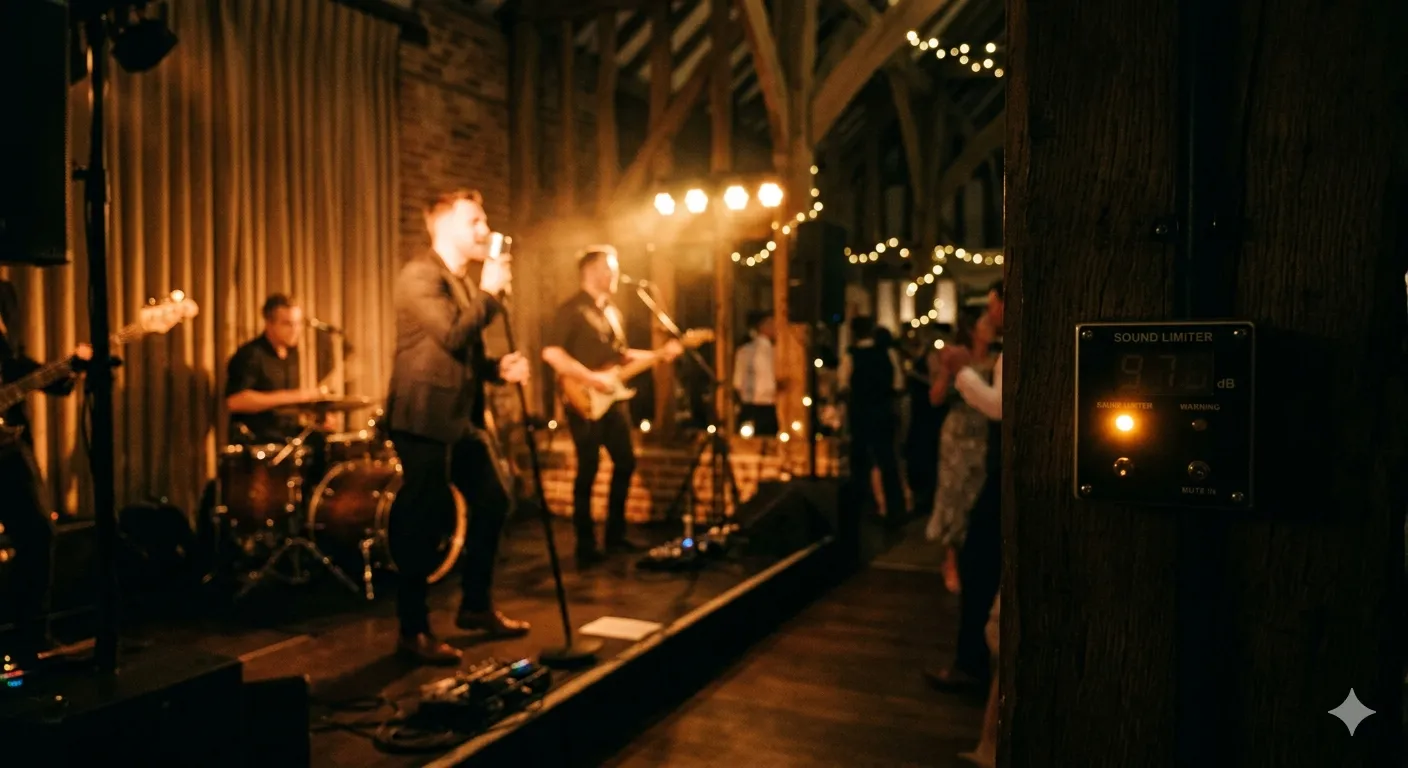
Noise Limiters & Sound Ceilings: What Every Couple Needs to Know Before Booking a Wedding Band
If you're planning a live band for your wedding or event, there's a question you should be asking your venue — and most couples never think to ask it until it's too late.
Does your venue have a noise limiter?
The answer, increasingly, is yes. And if it does, it will have a direct and sometimes significant impact on your live music experience. Not because your band isn't good enough, but because of a piece of electronic equipment bolted to the wall that nobody told you about when you signed the venue contract.
What is a noise limiter?
A noise limiter is a device that monitors sound levels in your venue and automatically cuts the power to the PA system — the speakers, the amplification, everything — the moment the noise in the room exceeds a set threshold. It is installed by the venue, usually as a condition of their licence. The band has no control over it. When it trips, the music stops.
And here's the thing that surprises most couples when they first hear it: the limiter doesn't just measure the band. It measures the whole room. Crowd noise, clapping, cheering, the acoustics of the building itself — all of it counts. A lively dancefloor full of excited guests can be enough to trip a limiter even when the band is playing quietly. When that happens, the power cuts and the music stops until the system resets.
What about sound ceilings and vertical arrays?
Some venues go a step further and install what's known as a vertical array or sound ceiling system — speakers mounted overhead that direct audio downwards rather than projecting it outward from the stage. The intention is to contain the sound within the room.
In theory, it sounds sensible. In practice, it is one of the most acoustically limiting systems you can encounter as a live music venue. The deep, warm, physical experience of a live band — the way bass frequencies move through you, the directionality of the sound, the sense of energy filling a room — simply doesn't translate through a vertical array. The music can sound thin and contained, the band can struggle to hear themselves on stage, and the atmosphere is fundamentally different to what you'd experience with a conventional live PA.
Can bands still play in these venues?
Yes — and they do, all the time. With the right preparation, good communication between the band and the venue's audio team, and honest expectation-setting, it is entirely possible to have a wonderful live music experience in a limited venue.
But it won't be the same as an unrestricted one. The volume will be lower. The energy will be more contained. And at times, the limiter may trip. That's the reality, and we think you deserve to know it.
The most important thing you can do right now — before you book anything — is ask your venue some direct questions: Is there a noise limiter, and what is its decibel threshold? Is there a vertical array system? Can the band use their own PA? The answers will shape everything.
Want to know more?
We've put together a full guidance document covering everything in detail — from how limiters work in practice, to what to ask your venue, to what to do if the restrictions are too severe for a live band.
📄 Read the full venue guidance document — Understanding Noise Limiters & Sound Ceilings
We've also produced a short presentation that walks you through the key points visually:
And if you'd prefer to listen, we've recorded a narrated version you can watch in your own time:
If you have questions about your specific venue — or you're not sure whether a live band is the right fit — get in touch. We'd rather have an honest conversation upfront than leave you disappointed on the day.
Frequently Asked Questions
What is a noise limiter, and why does my venue have one?
A noise limiter is an electronic device that monitors sound levels in your venue and automatically cuts the power to the PA system if the noise exceeds a set threshold. Venues install them — usually as a legal requirement — to comply with their operating licence or planning conditions, particularly where the venue is close to residential properties.
Will a noise limiter ruin our evening?
Not necessarily — but it will affect it. With the right band, proper communication with your venue, and honest expectations going in, you can still have a fantastic live music experience. What a limiter will change is the volume, the energy, and occasionally the continuity of the performance if it trips. We'll always be upfront with you about what to expect.
What happens when the limiter trips?
The power to the sound system cuts out and the music stops. Depending on the system, there may be a warning light before the cut, or it may be instantaneous. The band then has to wait — typically 30 seconds or more — for the limiter to reset before they can resume playing at a reduced volume.
Can the band just play more quietly to avoid triggering it?
To a degree, yes — but it's not as simple as it sounds. Drums are acoustic instruments that generate significant noise regardless of amplification. Even a band playing as gently as possible can push close to a low limiter threshold. Some bands use electronic drum kits in restricted venues, which helps, but changes the sound and feel of the performance.
What is a vertical array or sound ceiling system?
A vertical array is a speaker system where audio is directed downwards from ceiling-mounted speakers, rather than projected outward from a conventional stage-level PA. Some venues install these to contain sound within the room. While they do the job of keeping noise levels controlled, they produce a noticeably different — and generally less impactful — listening experience compared to a standard live PA.
How does a vertical array affect the quality of the performance?
Significantly. The physical energy and atmosphere of a live band — particularly the bass and the sense of sound filling a room — doesn't translate well through a vertical array. The music can sound thin or contained, and the band may also struggle to hear themselves clearly on stage, which affects their performance. It is not a like-for-like alternative to a conventional PA system.
What decibel level should I look out for when asking my venue?
As a rough guide, anything above 95dB gives a band reasonable scope to perform well. Thresholds below 90dB can be genuinely challenging, particularly for a full live band with acoustic drums. The lower the threshold, the greater the constraint — and the more important it is to discuss this with us before booking.
What questions should I ask my venue about their audio set-up?
The key ones are: Do you have a noise limiter, and what is the decibel threshold? Is there a warning before it trips? Do you have a vertical array or sound ceiling? Can the band use their own PA? Have you hosted live bands in this configuration before, and how did they find it?
Should I tell you about the noise limiter when I enquire?
Please do — it's one of the most useful pieces of information you can give us. It lets us match you with a band that has experience in restricted venues, set honest expectations from the start, and advise you if the restrictions are likely to be a problem. If you're not sure what your venue has, tell us the venue name and we'll try to find out.
Are there situations where a noise limiter means a live band isn't the right choice?
Yes, and we'll always be honest with you if that's the case. If the limiter threshold is very low, if the venue prohibits a live drum kit, or if you're required to use a vertical array with no supplementary monitoring, the constraints may simply be too great for a full live band to deliver the experience you're hoping for. In those cases, we can discuss alternatives — acoustic acts, specially configured ensembles, or DJs — that may work better in your venue.