
Phone Free Weddings: Why Your Band Plays Better to Faces Than Screens
On 28 September, IQ Magazine reported that phone free concerts are now reaching arena level. The idea has moved a long way from the cult experiment it was when Jack White locked audience phones in pouches for his 2018 tour. This August, the Edinburgh International Festival made its Queen's Hall series a phone free environment for the first time. Fabric and Fold in London already run phone free dancefloors, and Manchester's Warehouse Project followed with its Concourse room last year. The professional live music sector has reached a view that couples planning a wedding rarely hear from anyone: a room full of raised screens is a worse room to play to, and a worse room to be in.
That matters more at a wedding than at almost any other gig. A concert audience has paid to watch an artist. A wedding audience is there for two people, and the band's job is to turn a hundred and twenty guests who half know each other into one dancefloor. Phones work directly against that job. This is the case for taking them out of the evening, written from the side of the stage that sees the difference every weekend.
Why the live industry is quietly taking phones back
The arguments being made by promoters and festival directors are not about nostalgia. They are about what a live audience is for. Announcing the Edinburgh policy, which the festival called Lights Down, Phones Off, festival director Nicola Benedetti said: "When the lights go down and the performance starts, we would like phones to disappear from our hands, minds and ears." The festival was blunt about why. Phones had interrupted every single concert in its 2025 Queen's Hall chamber series, and audiences and artists had both told it they found them disruptive.
The club world reached the same place from the opposite end of the music. When Warehouse Project introduced its no phones policy, founder Sam Kandel said: "We want to take the clubbing experience back to its core, which is being in a room with like minded people feeling connected through music." Then he added the line that every wedding couple should read twice: "We also want people to have a piece of the night to remember it by and share with friends, which is why we are sharing our amazing content with everyone at the end of the evening."
That second sentence is the whole model. Nobody is asking guests to give up the memory. They are asking guests to hand the job of recording it to someone whose job it is, and to spend the night in the room instead.
What a wedding band actually sees from the stage
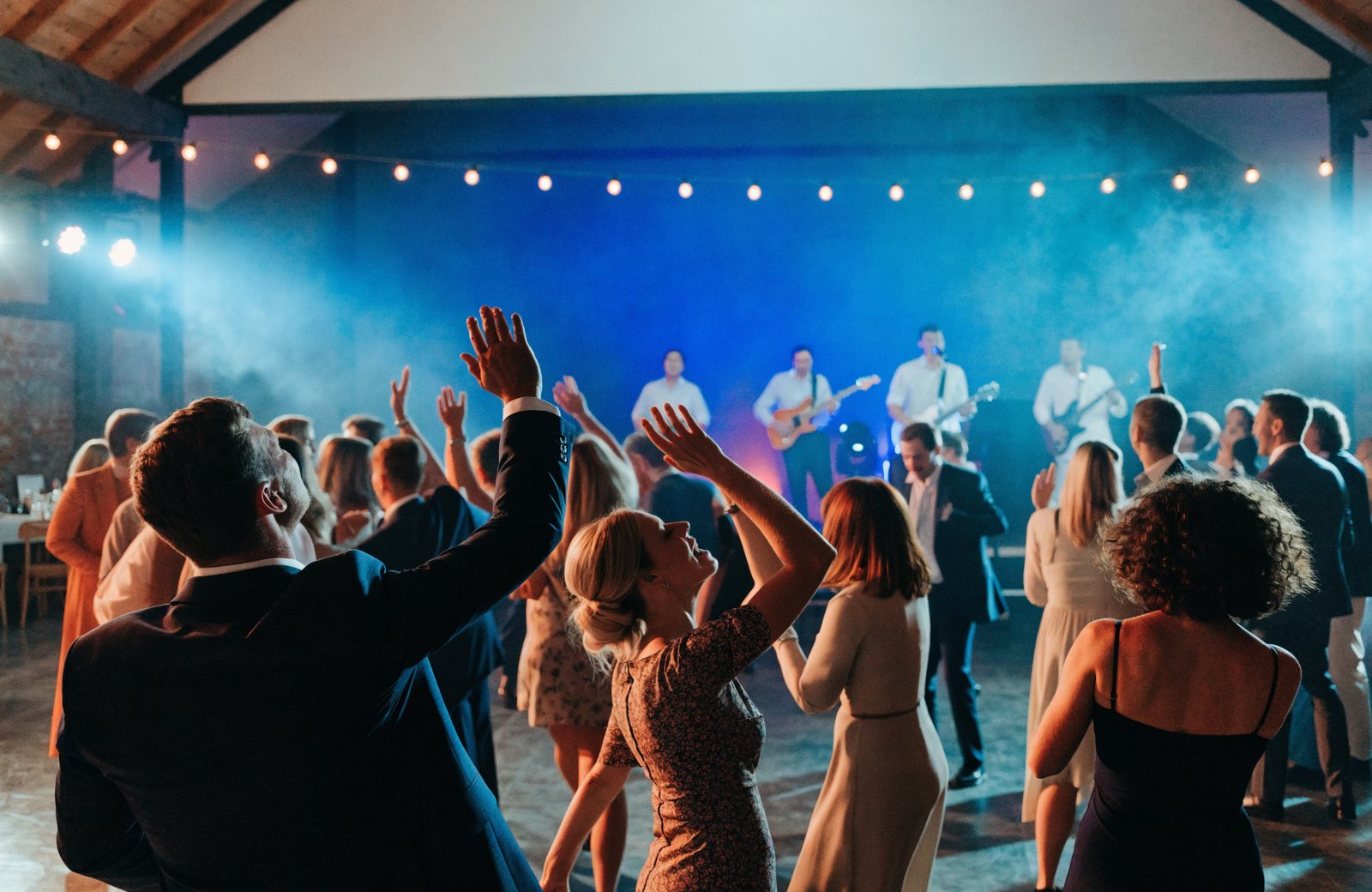
A function band reads the room constantly. The set list on paper is a starting point; the set list that gets played is decided song by song by watching who is on the floor, who is hovering at the edge, and which table of aunties needs one more Motown number before they commit. The cues are faces, feet and hands. When a third of the front row is holding a phone at head height, the band loses those cues. The singer cannot see whether the chorus has landed, the drummer cannot see the floor fill, and the bandleader is guessing at the next song rather than choosing it.
Ian Montone, who has managed Jack White and LCD Soundsystem, put the audience side of it plainly when Rolling Stone covered phone free shows: "No one wants to be standing behind 1,000 phones filming the entire show." At a wedding the numbers are smaller and the effect is sharper. Ten guests filming the first dance from the edge of the floor are ten guests not dancing in the second song, and the second song is where a dancefloor is either built or lost. Energy at a wedding is contagious in both directions. People join a floor that looks full and committed. They hang back from one that looks like an audience.
There is a sound engineering point too. Guests filming tend to stand still and stand close, which pushes people into the space directly in front of the PA and the vocal monitor. That is the worst place in the room to hear the band and the most likely place for a guest to step on a cable or knock a stand. Musicians notice the difference between a crowd that moves and a crowd that films.
The unplugged ceremony is the easiest place to start
If going fully phone free feels like too much, the ceremony is where the case is strongest and the request is easiest to make. Wedding photographers have argued for unplugged ceremonies for years, for a simple reason: the processional photograph a couple will frame is ruined by a row of guests leaning into the aisle with their screens up. A ceremony musician or string quartet sees the same thing from the side. The moment the doors open is the moment every head should turn, and instead every arm goes up.
An unplugged ceremony asks for twenty or thirty minutes without phones, in a setting where silence is already expected. The registrar or celebrant can make the announcement, which removes any awkwardness for the couple. Guests are told the photographer has it covered and that the images will be shared. Almost nobody objects, because almost nobody actually wants to watch a wedding through a phone screen. They do it because everyone else is.
Once a couple has seen how a phone free ceremony feels, the evening becomes an easier conversation.
How to make the evening phone light without policing guests
Nobody needs to hire security or hand out locking pouches at a wedding. What works is the approach Warehouse Project used: give people a reason to put the phone away and a promise that the content will come to them. In practice that comes down to a handful of decisions made well before the day.
First, decide which moments matter. The first dance, the first song of the band's opening set and the last song of the night are the three where a full, phone free floor makes the biggest difference. Many couples choose to ask for phones away during those three moments only, which is a request guests can remember and respect.
Second, tell your band. A good bandleader can make the ask from the microphone in a way that sounds like an invitation rather than a rule, and can time it so the floor fills at the same moment the phones go down. It sounds very different coming from the stage than from a sign on the bar. Talk to them about it when you go through your set list and timings, not on the night.
Third, book the coverage that makes the ask fair. If you are asking guests not to film, your photographer and videographer need to be there for those moments and need to know the plan. Agree a turnaround for sharing a handful of images or a short clip, ideally within a day or two, so guests have something to post. That is precisely the trade Sam Kandel described.
Finally, give the phones somewhere to be. A table by the entrance, a basket at the bar, or simply a line in the order of the day asking guests to keep them in pockets during the first dance. The point is to make putting the phone down the normal thing to do in that room.
What phone free weddings mean for working musicians
For bands, this is a commercial conversation as much as an artistic one. The function circuit has spent a decade being sold on social media, and many acts rely on guest footage tagged on Instagram and TikTok to win their next booking. A phone free evening appears to cut that off. It does not have to. Bands that work with the couple's videographer, or that run their own discreet static camera on the stage for content, get footage that is better lit, better framed and better recorded than anything filmed on a phone from the third row. It also arrives with the couple's permission, which guest footage never does.
There is a gain on the night as well. A band playing to faces rather than screens plays a better show, and a better show is the thing that wins referrals from the guests who were there. The people who book function bands in 2027 are, in large numbers, the guests dancing at weddings in 2026. Every one of them who remembers the night rather than the footage is a better lead.
The professional live sector is drawing a line between a crowd that is present and a crowd that is recording. Bands that understand that line, and can explain it to a couple in a pre wedding call without sounding precious, will be the ones couples trust with the evening. We made a related point last week about rooms built specifically to be filmed: in our piece on Apple Music Hall at Battersea, the camera is part of the deal. At a wedding, it should be the exception.
A wedding is the one gig where the audience and the occasion are the same thing. Asking guests to put their phones down for the moments that matter is not about control. It gives the room back to the people in it, and gives the band the faces it needs to read the floor. The footage will still exist. It will just be shot by someone who is not supposed to be dancing.